
Why Pest Control for Carpenter Ants Can’t Wait
The short answer: Carpenter ants are one of the most destructive pests found in New England homes. If you’re seeing large black ants — especially near wood, windows, or damp areas — here’s what to do first:
Quick answer: What to do if you see carpenter ants
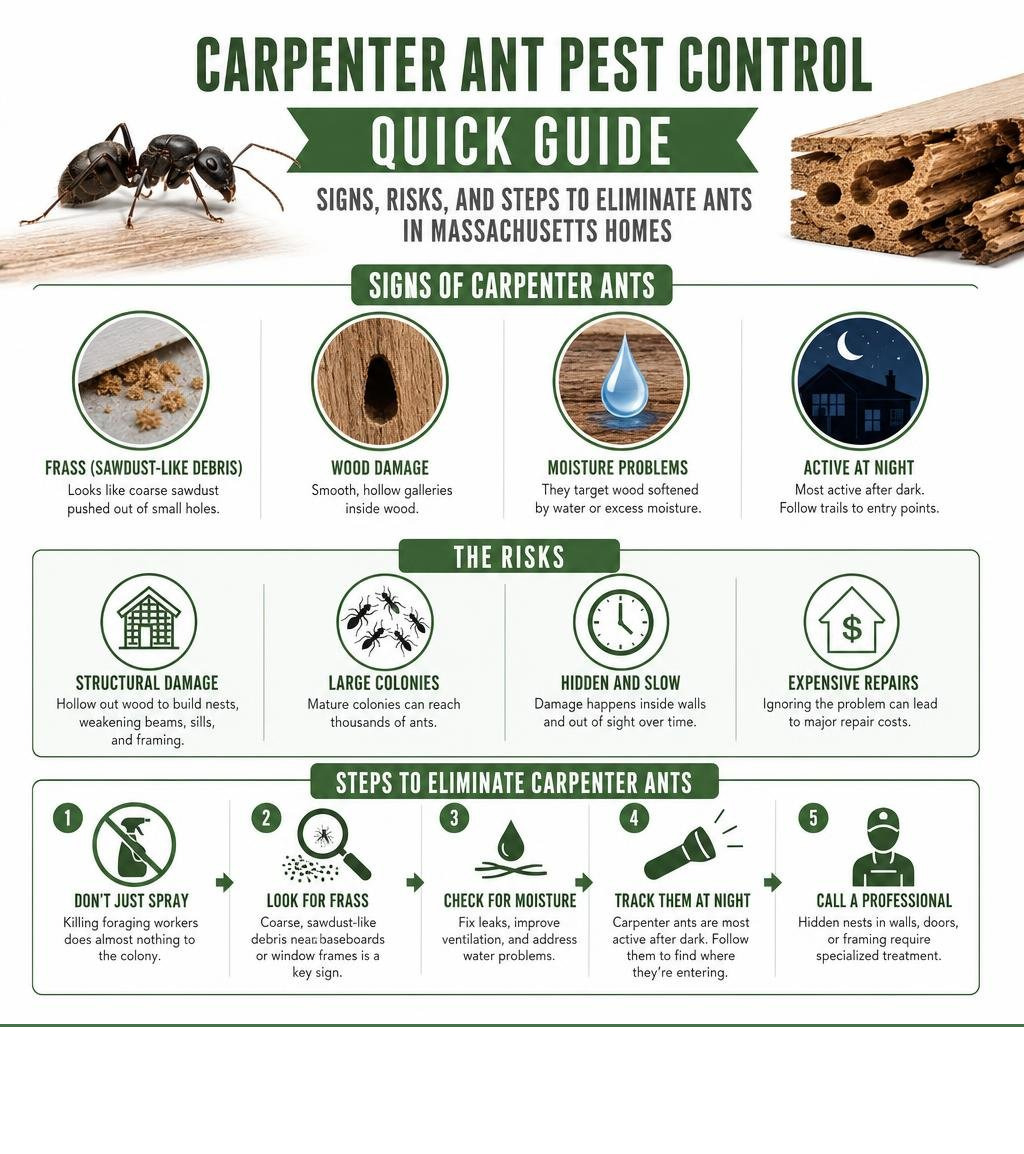
- Don’t just spray them. Killing foraging workers does almost nothing to the colony.
- Look for frass. Coarse, sawdust-like debris near baseboards or window frames is a key sign of nesting activity.
- Check for moisture problems. Carpenter ants almost always target wood that has been softened by water damage.
- Track them at night. Carpenter ants are most active after dark. Follow them to find where they’re entering.
- Call a professional if the nest is hidden. Nests inside walls, hollow doors, or structural framing require specialized treatment.
If you’ve spotted large dark ants crawling across your kitchen counter or heard a faint rustling sound inside your walls at night, you already know something is wrong. Carpenter ants are the most common ant species found in Massachusetts homes — and across Essex County and the northern part of Middlesex County, Massachusetts, they’re a year-round concern for homeowners.
Unlike most ants that are simply a nuisance, carpenter ants can cause real structural damage. They don’t eat wood — but they hollow it out to build their nests, carving smooth tunnels through beams, sills, and framing over months and years. A mature colony can hold up to 10,000 individuals, and by the time most homeowners notice the problem, significant damage may already be underway.
The good news: with the right approach, carpenter ants can be fully eliminated and kept out for good.
This guide covers everything you need — from identifying an infestation to choosing the most effective treatment and preventing future problems.
What Are Carpenter Ants and How to Identify Them
To protect your home, you first need to know exactly what you are dealing with. Carpenter ants are among the largest ants in the United States, ranging from 3.4 to 13 mm in length. Unlike many other ant species that look completely identical to one another, carpenter ants display “polymorphism.” This means that workers within the exact same colony can vary significantly in size, usually ranging from 3/8 inch to 1/2 inch long, while some smaller species are only 3/16 inch. The queen is the largest of all, sometimes reaching a full inch in length.
In Massachusetts, the most common culprit is the black carpenter ant (Camponotus pennsylvanicus). True to its name, this species is typically dark brownish-black all over, though some other species found in New England can be bicolored, showing a reddish-brown thorax (midsection) and a black abdomen.
Understanding the social structure of these insects is key to eliminating them. To learn more about how these colonies organize themselves and why they are so persistent, read our detailed guide on Massachusetts Carpenter Ants: Colony Structure and Habits.
Distinguishing Carpenter Ants from Termites and Other Species
Homeowners often panic when they see winged insects emerging inside their homes, immediately fearing a massive termite infestation. While both pests damage wood, they are biologically very different. Distinguishing between them is crucial for applying the correct treatment.
Here is a quick breakdown to help you tell them apart:
If you are seeing smaller, uniform ants trailing near your patio or kitchen floor, you may be dealing with pavement ants or odorous house ants (which smell like rotten coconuts when crushed) rather than wood-destroying pests. For help identifying smaller species, check out our comprehensive guide on Ant Control.
Signs of a Carpenter Ant Infestation in Your Home
Because carpenter ants do most of their heavy lifting hidden inside walls, you have to look for subtle clues. Here are the primary signs that you need professional pest control carpenter ants services:
- Frass Piles: As these ants excavate wood, they must get rid of the debris. They push it out of small, slit-like openings in the wood. This debris, known as frass, looks like piles of fine, uniform wood shavings (similar to pencil shavings) and almost always contains fragments of dead insect parts.
- Rustling Sounds: When a colony is active inside a wall, attic, or hollow door, you can actually hear them. If you listen closely at night, you may hear a dry, rustling sound—similar to cellophane crinkling—as they click their mandibles and move through their galleries.
- Winged Swarmers: Seeing large, winged ants inside your home is a major warning sign. These are reproductive ants looking to start new colonies. Finding them indoors, especially during the late winter or spring, strongly indicates an established nest inside the structure.
- Consistent Sightings: Seeing a single ant indoors during the summer might just be a scout wandering in from the yard. However, consistent sightings of 20 or more worker ants indoors is a clear sign of an active nest nearby.
For a deeper dive into what to look for around your property, read our article on the Signs of Carpenter Ants in Massachusetts Homes.
Understanding Carpenter Ant Damage and Nesting Habits
To effectively solve a carpenter ant problem, you have to understand how they interact with your home. Unlike termites, carpenter ants do not eat wood. They do not possess the enzymes required to digest cellulose. Instead, they use their powerful mandibles to chew through wood, excavating clean tunnels and galleries solely to create nesting space.
Because they keep their galleries pristine, their tunnels have a smooth, sandpaper-like finish. This is a stark contrast to termite galleries, which are typically packed with mud and moist soil.
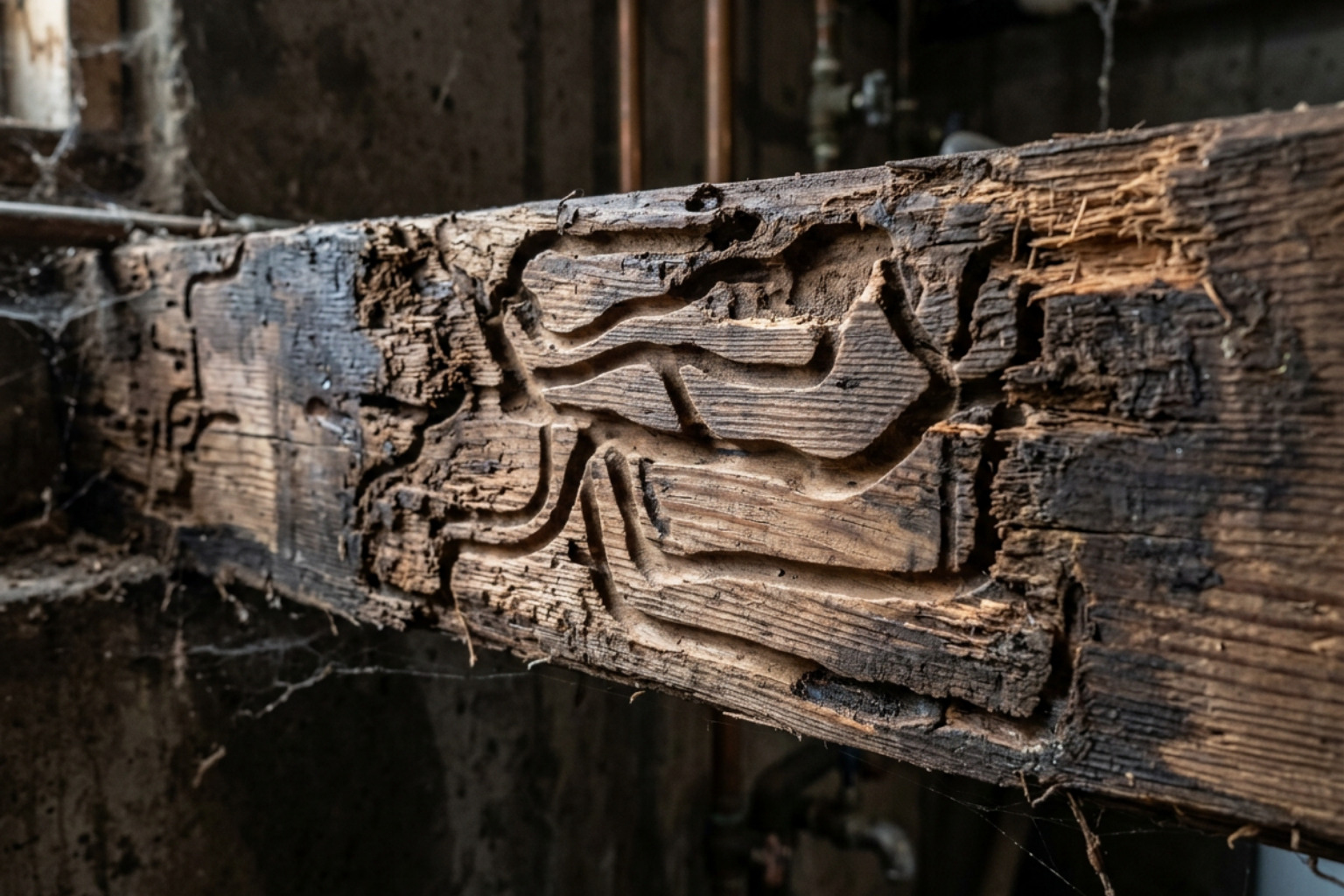
The primary driver for carpenter ant nesting is moisture. They prefer wood that has been softened by water damage, fungal decay, or rot. This is why infestations are so frequently linked to underlying plumbing leaks, roof leaks, or poor ventilation in crawl spaces and attics.
To understand their long-term survival, you must also understand their colony dynamics. Carpenter ants utilize a system of “parent” and “satellite” colonies:
- The Parent Nest: This is the main colony where the queen resides, along with eggs and very young larvae. Because the queen and eggs require high humidity to survive, the parent nest is almost always located outdoors in a highly moist environment, such as a rotting tree stump, a dead log, or a damp woodpile.
- Satellite Nests: When the parent colony grows too large (often containing over 2,000 to 10,000 workers), they establish satellite nests. These nests contain mature larvae, pupae, and thousands of workers, but no queen or eggs. Because they do not have fragile eggs to protect, satellite nests can thrive in much drier environments, including the dry wall voids, attics, and hollow doors inside your home.
This colony structure is why simple DIY spraying fails. If you only treat the satellite nest inside your living room, the parent colony outdoors will simply send more workers to replace them. For a complete breakdown of this behavior, explore Carpenter Ants: What to Look For – Understanding Colony Structure and Infestation Signs.
Common Indoor and Outdoor Nesting Sites
When searching for nests, pest control professionals focus on areas where wood meets moisture.
Common Indoor Sites:
- Wall voids near leaking pipes, bathtubs, or sinks
- Wood framing around poorly sealed windows and exterior doors
- Roof eaves and soffits damaged by clogged gutters or ice dams
- Foam insulation panels (which are incredibly easy for ants to tunnel through)
- Hollow-core interior doors
Common Outdoor Sites:
- Dead trees, rotting stumps, and firewood piles
- Wooden decks, porches, and fence posts in direct contact with the soil
- Tree branches that overhang and physically touch the roof or siding
- Areas beneath decorative landscaping mulch
Effective and Non-Toxic Methods for Controlling Carpenter Ants
At Eastern Pine Pest Control, we believe in solving pest problems at the source using Integrated Pest Management (IPM). This means we don’t just spray chemicals everywhere; we combine biological understanding, structural repairs, and targeted treatments to eliminate pests safely.
If you want to address carpenter ants using low-toxicity or non-chemical methods, focus on these steps:
- Correct the Moisture Source: Since carpenter ants are drawn to moisture, your first step must be fixing leaks, repairing gutters, and improving ventilation. Dry wood is highly resistant to carpenter ant tunneling.
- Physical Exclusion: Seal the gaps they use to get inside. Use high-quality silicone caulk to seal cracks in your foundation, gaps around utility lines, and spaces around windows.
- Targeted Insecticidal Dusts: For nests hidden inside wall voids, a professional can drill tiny, 1/8-inch holes and inject natural silica or borate-based dusts directly into the cavity. These dusts cling to the ants’ bodies and wear down their outer shells without exposing your family or pets to airborne sprays.
- Granular and Gel Baits: When the exact location of a nest is unknown, delayed-action baits are highly effective. These baits use low-toxicity active ingredients (like abamectin) designed to let the ants feed and carry the bait back to the parent and satellite nests, slowly eliminating the colony from the inside out.
While managing wood-boring pests, you might also notice other wood-nesting insects active around your home in the spring. To learn about other local wood-nesting species, read about Spring Carpenter Bee Activity in Massachusetts: What You Need to Know.
Professional Pest Control: Carpenter Ants Solutions
When dealing with an active, structural infestation in Essex County or the northern part of Middlesex County, Massachusetts, professional intervention is often the safest and fastest path to peace of mind. At Eastern Pine Pest Control, we provide specialized pest control carpenter ants treatments customized for New England homes.
Our local experts understand the unique architecture of historic homes in towns like South Hamilton, Ipswich, Reading, and Beverly. We don’t just apply a generic perimeter spray. Our process involves:
- A Detailed Inspection: Using moisture meters and specialized tools to locate hidden parent and satellite nests.
- Targeted Void Treatments: Injecting precise, low-toxicity treatments directly into active nesting galleries.
- Non-Repellent Liquid Barriers: Applying specialized materials around the foundation that ants cannot detect. They walk through it, carry it back to the colony, and pass it to the queen, ensuring total colony elimination.
Why DIY Fails and When to Seek Professional Pest Control: Carpenter Ants Experts
Many homeowners try to tackle carpenter ants with over-the-counter sprays. Unfortunately, this often makes the problem worse.
Standard retail sprays are highly repellent. When you spray foraging ants in your kitchen, you only kill the 10-15% of the colony that is actively searching for food. The remaining ants inside the wall sense the chemical threat, trigger a survival response called “budding,” and scatter deeper into your home to establish new, smaller nests.
Furthermore, because workers can travel up to 100 yards from their parent nest in search of food, the root of your infestation might be a rotting log in your neighbor’s yard. Locating these pathways requires professional training, specialized equipment, and access to commercial-grade, non-repellent products that are safe for your family and pets.
Preventing Future Carpenter Ant Infestations
Once your active infestation is cleared, keeping them gone requires a few simple maintenance habits around your yard and home:
- Trim Your Landscaping: Keep tree branches, shrubs, and ivy trimmed back at least 6 to 12 inches away from your roof, siding, and foundation. Ants routinely use overhanging branches as bridges to bypass ground-level treatments.
- Manage Firewood Properly: Store firewood off the ground, covered, and at least 20 feet away from your home. Only bring in the wood you plan to burn immediately, as firewood piles are prime real estate for parent colonies.
- Divert Water Away: Ensure your gutters are clean and downspouts direct water at least 3 to 4 feet away from your foundation.
- Seal Ground-Level Entry Points: Caulk gaps around outdoor spigots, electrical conduits, and basement windows.
Integrated Pest Control: Carpenter Ants Prevention and Long-Term Protection
For complete peace of mind, seasonal protection is highly recommended. Our year-round pest prevention programs are designed to protect your home through changing New England seasons.
By performing tri-annual inspections and targeted exterior treatments, we stop carpenter ants, rodents, wasps, and other common pests before they ever find a way inside. This proactive approach minimizes chemical use indoors and focuses on keeping your home’s exterior envelope secure and pest-free.
Frequently Asked Questions about Carpenter Ants
Do carpenter ants eat wood?
No, carpenter ants do not eat wood. They only chew through it to excavate nesting galleries. Their actual diet consists of sweets, proteins, and “honeydew”—a sweet liquid produced by aphids and scale insects found on outdoor plants. Indoors, they will readily feed on grease, meat, honey, sugar, and food crumbs.
Why am I seeing winged ants inside my house?
Seeing winged ants indoors, especially in late winter or early spring, almost always means there is an established nest inside your home’s structure. These are winged reproductives (swarmers) emerging from a mature colony (usually 6 to 10 years old) to mate and establish new nests.
Are flying carpenter ants destructive to homes?
The winged swarmers themselves do not damage wood. Their sole purpose is to reproduce and establish new colonies. However, finding flying carpenter ants inside your home is often a sign that a mature colony is present either within the structure or very nearby.
The real damage is caused by worker carpenter ants, which excavate galleries in wood to expand their nest. They are especially attracted to wood that has been softened by excess moisture or previous decay. Over time, untreated infestations can enlarge these galleries and damage window frames, door frames, wall voids, sills, decks, and other wooden structural components. While significant structural damage is uncommon, long-term infestations can become costly to repair if they are not addressed.
Are carpenter ants nocturnal?
Carpenter ants are most active at night, but they are not strictly nocturnal. Although carpenter ants are typically most active after dark, they can often be seen during the daytime. Finding carpenter ants during the day doesn’t necessarily indicate a severe infestation—it simply means workers are actively searching for food, particularly during the spring and summer months or when food and moisture are readily available.
How much does professional carpenter ant treatment cost in Massachusetts?
The cost of professional treatment depends on several factors, including the size of your home, the accessibility of the nests, and the severity of the infestation. Because every home is unique, Eastern Pine Pest Control provides free, no-obligation inspections and custom quotes to ensure you get the exact treatment you need without paying for unnecessary services.
Conclusion
Carpenter ants are incredibly resilient, highly organized, and capable of causing quiet, expensive damage to your home. But you don’t have to deal with them alone.
At Eastern Pine Pest Control, we are proud to be the trusted local authority on safe, effective, and long-term pest control. Serving South Hamilton, Reading, Beverly, Danvers, and communities throughout Essex County and the northern part of Middlesex County, Massachusetts, our family-safe, source-focused treatments are designed to protect your home and give you lasting peace of mind.
Don’t let carpenter ants tunnel away at your home’s value. Get Professional Ant Control Today and schedule your inspection with our local experts.