
Big Carpenter Ants with Wings Are a Warning Sign — Here’s What to Know
Big carpenter ants with wings are not a new species or a random visitor. They are reproductive members — called swarmers or alates — of an existing carpenter ant colony. When you see them, it almost always means a mature colony is nearby.
Quick answer: What are big carpenter ants with wings?
- They are winged reproductive carpenter ants (males and females) released from a mature colony to mate
- They are large — workers range from 1/4 to 1/2 inch; winged reproductives and queens can reach up to 3/4 inch
- They appear mainly in spring and early summer during warm, humid weather
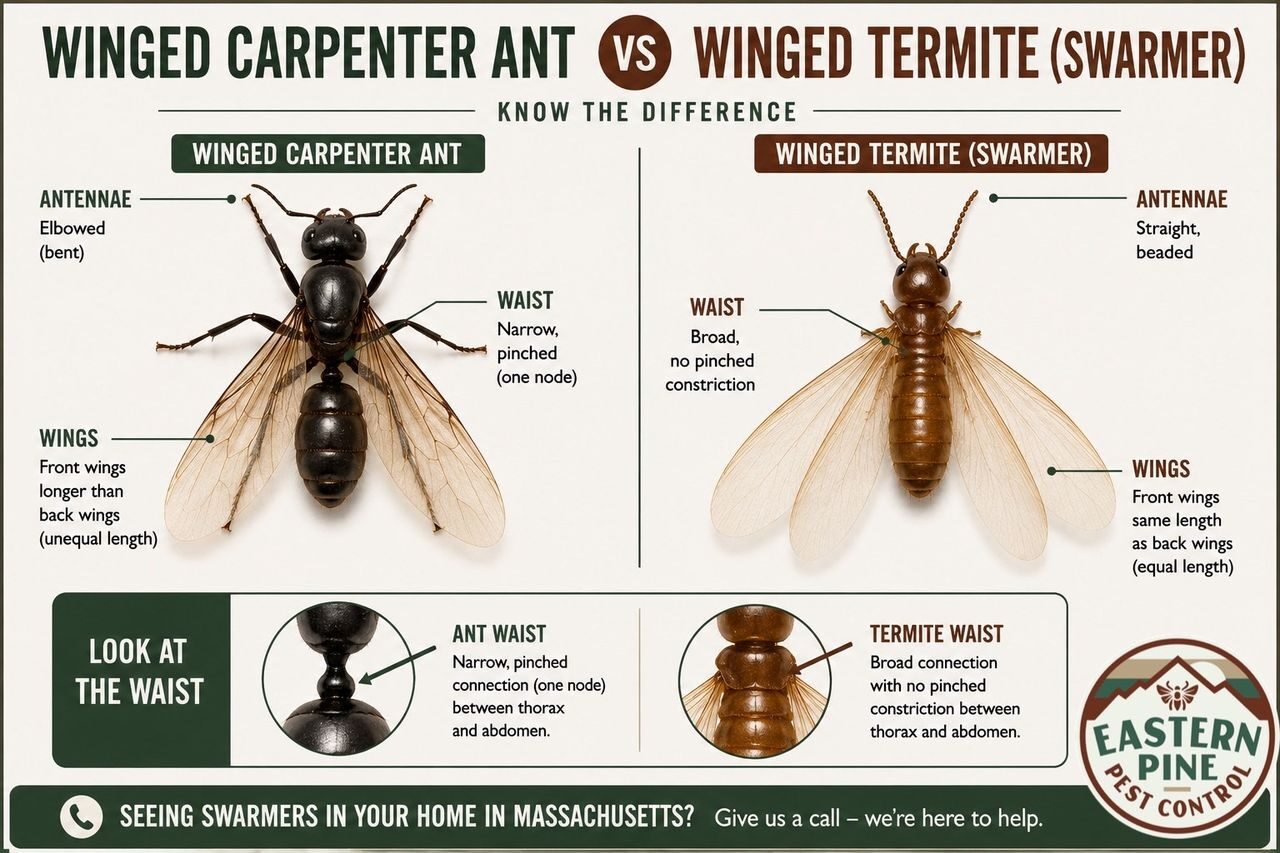
- They have elbowed antennae, a pinched waist, and two pairs of unequal wings (front pair longer)
- They do not eat wood — but the colony they come from can cause serious structural damage
- Finding them inside your home is a red flag that a colony may already be nesting in your walls, attic, or moisture-damaged wood
If you’re a homeowner in Essex County or the North Shore of Massachusetts, spring 2026 is already peak swarming season. Seeing a handful of large winged ants near a window or in your kitchen is easy to dismiss. But it’s often the first visible sign of a carpenter ant problem that’s been building for years.
This guide covers everything you need to know — identification, what their presence means, and how to deal with them.
What Are Big Carpenter Ants with Wings?
In the North Shore of Massachusetts, the most common species we encounter is the black carpenter ant (Camponotus pennsylvanicus). In nature, these ants serve a vital ecological purpose by nesting in decaying logs and helping decompose dead trees. However, when they migrate into residential properties in areas like Beverly, Danvers, or South Hamilton, they quickly transition from helpful decomposers to destructive structural pests.
The big carpenter ants with wings that you see are the reproductive caste of the colony. Unlike the wingless sterile workers that forage for food, these winged individuals (also known as alates or swarmers) have one job: to leave the nest, mate, and establish new colonies.
A mature carpenter ant colony is a highly organized machine that can contain as many as 10,000 to 15,000 individuals. To understand how these winged ants fit into the larger picture of an infestation, it is helpful to look at how their society is organized. You can read more about this in our guide on Massachusetts Carpenter Ants Colony Structure and Habits.
Why Do We See Big Carpenter Ants with Wings in Spring?
If you suddenly find your kitchen or bathroom windows covered in large flying ants, you are witnessing a phenomenon known as a “nuptial flight.” This seasonal swarming typically occurs in late spring or early summer, particularly on warm, humid days following a spring rain.
The mature colony releases hundreds of winged males and females simultaneously. The sudden appearance of these flying pests can be alarming for homeowners in towns like Lynnfield and Reading. The timing of these swarms is highly dependent on local weather patterns, temperature, and humidity levels. For more answers on local timing and swarming behaviors, check out our Frequently Asked Questions About Ant Control in Lynnfield Massachusetts.
The Role of Winged Queens and Swarmers
During the nuptial flight, the winged males and females mate mid-air. Once mating is complete, the male ants die, having fulfilled their only biological purpose. The fertilized females, now newly minted queens, drop to the ground to search for a suitable nesting site.
To prepare for her new underground or wood-bound life, the queen will physically break off her own wings. She will never fly again. If you find shed wings scattered on your window sills or near baseboards, it is a strong indication that a mated queen has recently chosen your home to start a new colony.
The queen then uses her powerful flight muscles — which she no longer needs — as an internal energy source, metabolizing them to sustain herself while she rears her first small batch of 15 to 20 eggs. A single carpenter ant queen is incredibly resilient and can live for 15 to 25 years, continuously producing generations of workers that will slowly expand the nest inside your home’s structural framing.
Winged Carpenter Ants vs. Termites: Key Differences
One of the most critical steps in home pest management is determining whether you are dealing with big carpenter ants with wings or winged termites. Both pests swarm at similar times of the year, but they require entirely different treatment strategies. Mistaking one for the other can lead to ineffective DIY treatments and ongoing structural damage.
To help you tell them apart quickly, refer to this comparison table:
For a deeper dive into what to look for when inspecting your property, read our article on Carpenter Ants What to Look For Understanding Colony Structure and Infestation Signs.
Physical Differences of Big Carpenter Ants with Wings
When looking closely at a swarmer, the waist is the easiest identifier. Carpenter ants have a distinct, narrow “wasp-like” waist (petiole) with a single node connecting the thorax and abdomen. Termites, on the other hand, have a broad body with no visible waist constriction.
Additionally, look at the wings. A carpenter ant’s front wings are significantly larger and longer than its hind wings, and they have distinct, dark veins. Termite wings are completely symmetrical, translucent, and extend far past the end of their abdomen.
Wood Damage Comparison: Excavation vs. Consumption
The way these two pests interact with your home’s wood is entirely different. Termites actually eat wood to digest the cellulose, leaving behind messy, mud-filled tunnels packed with soil and debris.
Carpenter ants do not eat wood. Instead, they use their powerful mandibles to chisel out the wood, creating incredibly smooth, clean galleries that look as though they have been sanded by a professional carpenter. They carry the excavated wood out of the nest and discard it, leaving behind piles of “frass” — a mixture of fine sawdust, insect fragments, and dirt — near the nest openings.
What Finding Swarmers Inside Your Massachusetts Home Means
If you find winged carpenter ants outside in your yard near an old tree stump, there is generally no immediate cause for panic. They are simply performing their natural role in the local ecosystem. However, finding big carpenter ants with wings inside your home is a major warning sign.
Because winged swarmers are relatively weak fliers, they rarely travel far from their parent nest. If you find dozens of them fluttering around your indoor light fixtures or crawling on your window screens, it almost certainly means there is an active, mature colony nesting somewhere inside your walls, ceiling, or floor joists.
It takes a carpenter ant colony three to six years to grow large enough (usually around 3,000 workers) to begin producing and releasing winged swarmers. This means that if you see swarmers indoors, the structural wood damage has likely been quietly occurring for several years. For more details on identifying these subtle red flags, refer to our guide on the Signs of Carpenter Ants in Massachusetts Homes.
Parent Colonies vs. Indoor Satellite Nests
To effectively manage a carpenter ant infestation, you must understand their nesting habits. Carpenter ants typically establish two types of nests:
- The Parent Nest: This is the primary colony where the queen, eggs, and youngest larvae live. Because the eggs require high humidity to survive, parent nests are almost always located outdoors in areas with constant moisture, such as rotting tree stumps, woodpiles, or dead tree limbs.
- Satellite Nests: When the parent colony grows too large, the workers expand by creating satellite nests. These nests contain mature larvae, pupae, and thousands of foraging workers. Because pupae do not require high levels of moisture, satellite nests are frequently established indoors in dry wall voids, hollow doors, attic insulation, and behind chimney flashing.
A single parent nest located 100 yards away in your backyard can support multiple indoor satellite nests inside your home’s structure.
Finding and Eliminating the Nest in North Shore Homes
Locating a hidden carpenter ant nest requires patience and observation. Because only 10% to 15% of the colony’s workers forage outside the nest at any given time, simply spraying the visible ants you see on your kitchen counter will do absolutely nothing to solve the root of the problem.
To track down the nest, try these practical steps:
- When to inspect: Although carpenter ants are typically most active after dark, they can often be seen during the daytime. Finding carpenter ants during the day doesn’t necessarily indicate a severe infestation—it simply means workers are actively searching for food.
- Listen closely: On quiet nights, tap on suspected wall voids or window frames. If a nest is present, you may hear a distinct rustling sound, similar to crinkling cellophane, which is the sound of the ants clicking their mandibles together when disturbed.
- Use sweet baits: Place small drops of honey or jelly near active trails. Once the workers find the food, they will form a straight line directly back to their hidden entry point in the wall.
For homeowners living in Middleton, Topsfield, or Ipswich, our targeted local advice in Mastering Ant Control Effective Strategies for Middleton Massachusetts provides excellent step-by-step techniques to help you locate and manage these pests.
Frequently Asked Questions About Flying Ants
Homeowners often have many questions when they first encounter large flying insects inside their homes. Here are the most common questions our team at Eastern Pine Pest Control receives during the spring swarming season.
Do winged carpenter ants bite or sting?
Unlike wasps or bees, winged carpenter ants do not possess a stinger. They do have powerful mandibles designed for chewing through wood, and they can pinch your skin if they are handled or feel threatened.
While the bite itself is relatively harmless and feels like a small pinch, carpenter ants have the ability to spray formic acid into the bite wound. This can cause a mild, temporary burning or itching sensation. However, they are not aggressive and will not seek you out to bite you.
Are flying carpenter ants destructive to homes?
The winged swarmers themselves do not chew wood or cause any physical damage to your home; their only role is reproduction. However, their presence is a clear indicator of a nearby mature colony of worker ants that are actively excavating your home’s structural framing.
Over several years, a large carpenter ant infestation can hollow out support beams, window headers, and floor joists, severely compromising the structural integrity of your property.
Are carpenter ants nocturnal?
Carpenter ants are most active at night, but they are not strictly nocturnal. It’s completely normal to see carpenter ants foraging during the day, particularly during the spring and summer months or when food and moisture are readily available.
How do I get rid of winged carpenter ants?
Eliminating an infestation for the long term requires an Integrated Pest Management (IPM) approach rather than relying on quick-fix chemical sprays.
- Control Moisture: Carpenter ants are highly attracted to soft, water-damaged wood. Repair roof leaks, fix plumbing drips, and ensure your gutters are clear and directing water away from your foundation.
- Remove Outdoor Food and Harborage: Keep firewood stacked off the ground and at least 20 feet away from your home. Trim back tree branches and shrubs so they do not make direct contact with your roof or siding, as ants use these branches as bridges to enter your home.
- Seal Entry Points: Use high-quality caulk to seal cracks in your foundation, gaps around utility pipes, and spaces around exterior doors and windows.
- Call the Experts: If you are seeing swarmers indoors, the nest is likely buried deep within a wall void. Professional pest control technicians have the specialized tools, such as wall-void injection equipment and non-repellent baits, to eliminate the parent and satellite nests at their source.
Conclusion
Finding big carpenter ants with wings inside your Massachusetts home can be stressful, but identifying them early is the key to protecting your property from long-term structural damage. At Eastern Pine Pest Control, we believe in solving pest problems at their source rather than relying on repetitive, temporary chemical sprays.
Serving the North Shore, including South Hamilton, Reading, Lynnfield, Beverly, and surrounding communities, our team specializes in Integrated Pest Management (IPM). We combine detailed inspections, moisture control recommendations, exclusion work, and targeted treatments to protect your home and family safely and effectively.
If you suspect you have a carpenter ant infestation or have spotted winged swarmers in your home, do not wait for the damage to worsen. Contact the local experts at Eastern Pine Pest Control today to schedule a comprehensive inspection and learn more about our professional Ant Control services.