
What Are Carpenter Winged Ants and Should You Be Worried?
Carpenter winged ants are the reproductive members of a carpenter ant colony — and spotting them inside your home is one of the clearest warning signs that a mature colony may be nearby.
Here’s what you need to know at a glance:
Quick answer: What are carpenter winged ants?
- What they are: Winged carpenter ants (also called alates or swarmers) are male and queen ants that develop wings in order to mate and start new colonies.
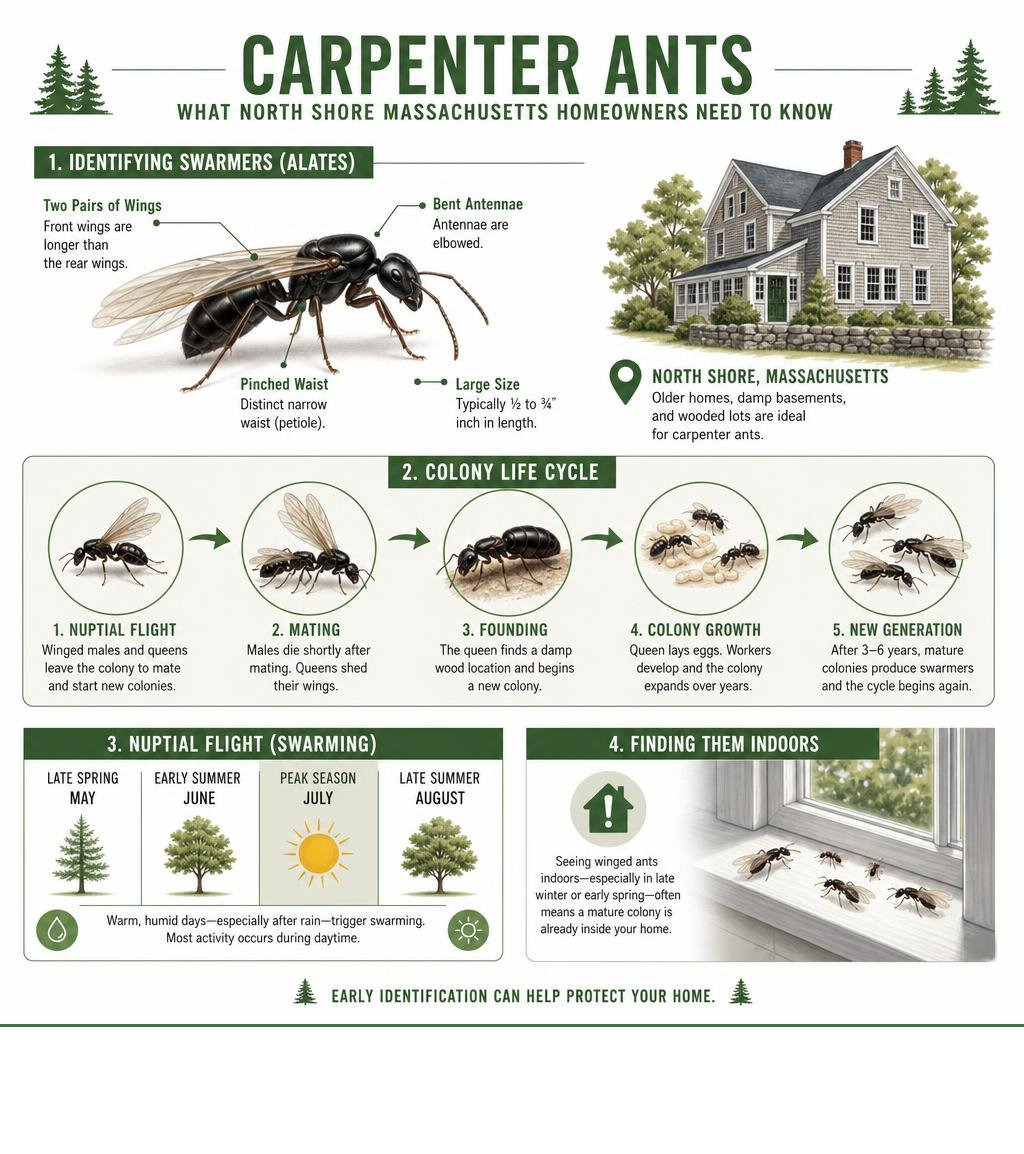
- What they look like: Large black ants with two pairs of wings — the front wings are noticeably longer than the rear wings. They have bent (elbowed) antennae and a pinched waist.
- What finding them indoors means: In summer, a single winged ant wandering inside may have just entered from outside. But finding them indoors in late winter or early spring — especially in numbers — strongly suggests an established colony is already inside your home.
- How serious is it? A colony mature enough to produce swarmers has likely been growing for 3 to 6 years. That’s a long time for wood excavation to go unnoticed.
For homeowners in Essex County and the North Shore of Massachusetts, carpenter ants are one of the most common structural pests. The region’s older wood-frame homes, damp basements, and wooded lots create ideal conditions for these insects to thrive.
This guide will walk you through how to identify them, what their presence means, and what to do about it.
Identifying Carpenter Winged Ants: Physical Traits and Castes
To the untrained eye, any large dark insect with wings crawling across a windowsill looks like a threat. However, identifying carpenter winged ants accurately is the first and most critical step in protecting your home.
In any active carpenter ant colony, there is a highly structured caste system. The vast majority of the ants you see throughout the year are wingless female workers, which range in size from 1/4 inch to 5/8 inch long. However, when a colony reaches maturity and environmental conditions are just right, it produces the reproductive caste: the winged alates (or swarmers).
These winged reproductives are split into two distinct groups:
- Queen Alates: These are the largest ants you will encounter in Massachusetts. A winged queen can measure anywhere from 1/2 inch to over 3/4 of an inch long (sometimes reaching a full inch). They have robust, swollen thoraxes designed to house flight muscles, and they carry large, smoky-brown wings.
- Male Swarmers: Considerably smaller than the queens, males usually measure between 1/3 inch and 1/2 inch long. They have much smaller heads, larger eyes, and narrower bodies, but they also possess wings for the sole purpose of taking flight to mate.
When examining these insects, look for these defining physical characteristics:
- Elbowed Antennae: Their antennae have a distinct, sharp “elbow” bend, unlike the straight or beaded antennae of other insects.
- Pinched Waist: They have a highly defined, constricted “wasp waist” with a single node (a small node or bump) between the thorax and abdomen.
- Unequal Wing Length: They have two pairs of wings (four wings total). The front pair of wings is significantly larger and longer than the hind pair, often extending past the end of the abdomen. The wings have a distinct amber or smoky-brown tint.
- Rounded Thorax: When viewed from the side, the thorax (the middle body segment) is evenly rounded and smooth, without any spikes or double ridges.
The Role of Alates in the Colony
The sole purpose of winged alates is reproduction and genetic dispersal. They do not forage, they do not excavate wood, and they do not care for the young. Instead, they represent the future of the species.
Once a parent colony reaches a mature size—which typically requires 4 to 6 years and a population of at least 2,000 to 3,000 workers—it begins producing 200 to 400 winged reproductive ants each year. These alates develop in late summer and fall, then spend the winter resting quietly inside the deep, protected galleries of the nest.
When spring arrives, these mature reproductives emerge simultaneously for their “nuptial flight.” During this event, hundreds of winged males and queens from various local colonies take to the air to mate. After mating, the males die almost immediately. The newly fertilized queens drop to the ground, chew off their own wings (leaving small scars on their thorax), and begin searching for damp, decaying wood to excavate their very first small chamber and lay their first batch of 15 to 20 eggs.
To learn more about how these complex family structures develop and operate in our local region, explore our detailed resource on Massachusetts Carpenter Ants Colony Structure and Habits.
How to Differentiate Termites from Carpenter Winged Ants
The most common and costly mistake a homeowner can make is confusing winged carpenter ants with termite swarmers. While both are wood-destroying organisms that produce winged reproductives, their biology, threat level, and treatment methods are entirely different.
Here is a quick visual and behavioral comparison to help you tell them apart:
If you are trying to determine exactly what kind of pest has invaded your property, keeping these physical indicators in mind is essential. For a deeper dive into what these differences mean for your home’s structural health, read our guide on Carpenter Ants: What to Look For – Understanding Colony Structure and Infestation Signs.
Why Winged Ants Appear Inside North Shore Homes
If you spot carpenter winged ants inside your home, it is natural to feel a sense of urgency. Understanding why they are there depends heavily on the time of year and where they are found.
In the warm summer months, finding a single winged queen or male inside does not automatically mean you have an active infestation. These insects can travel up to 100 yards from their nest in search of food or new nesting sites. A stray alate may have simply flown through an open door, slid through a screen tear, or drifted down a chimney.
However, if you find multiple winged ants inside during the late winter or early spring, the story is very different. Because outdoor temperatures in places like South Hamilton, Reading, and Ipswich are still cold during these months, outdoor colonies are dormant. If swarmers are active inside a heated house in January, February, or March, they are emerging from an established parent or satellite nest located directly within the home’s walls.
Our local New England architecture contributes to this problem. Many homes in Essex County and northern Middlesex County feature older timber frames, fieldstone foundations, and mature landscaping. These features, while charming, often present minor structural gaps and moisture issues that attract searching queens.
To help identify whether your property is showing these early warnings, review our guide on Signs of Carpenter Ants in Massachusetts Homes.
Why Do Carpenter Winged Ants Swarm Indoors?
When a colony is nested inside a home’s wall voids, the artificial heat from your home’s heating system can trick the ants into believing spring has arrived early.
Confused by the warmth, the winged alates will leave their deep nesting galleries and emerge into the living spaces of the home. Because they are naturally attracted to light, they will fly toward windows, glass doors, and light fixtures. This is why homeowners frequently find piles of discarded wings or struggling swarmers gathered on window sills.
Common indoor nesting sites include:
- Wall voids behind showers, bathtubs, and dishwashers
- Hollow-core doors
- Areas around leaky window frames and exterior doors
- Attic spaces near roof leaks or damaged shingles
- Structural sill plates in damp basements or crawl spaces
Seasonal Swarming Patterns in Massachusetts
Outdoors in Massachusetts, the natural swarming season typically runs from March through June, peaking on warm, humid days immediately following a heavy spring rain. The damp air and softened, rain-soaked soil or wood create the perfect environment for a newly mated queen to successfully dig her first nest chamber.
In the North Shore region, local microclimates play a major role. Coastal towns like Beverly, Salem, and Ipswich experience high humidity levels that can trigger coordinated swarms. Meanwhile, more inland wooded areas like Topsfield and Boxford provide abundant natural nesting sites in old tree stumps, meaning homes nearby face constant pressure from outdoor colonies looking to expand.
Nesting Habits and Structural Damage Risks
To effectively manage carpenter ants, you must understand how they interact with wood. Unlike termites, carpenter ants do not eat wood. They cannot digest cellulose. Instead, they use their powerful, bolt-cutter-like mandibles to chew through wood, physically excavating galleries and tunnels solely to create safe nesting spaces for their expanding colony.
Because they must carry all of their excavated wood out of the nest, their galleries are remarkably clean. They have a smooth, sandpapered appearance, completely free of the mud, soil, and gritty debris that termites leave behind.
Parent vs. Satellite Nests
One of the most challenging aspects of carpenter ant biology is their tendency to establish multiple, interconnected nests. A single mature colony often consists of:
- The Parent Nest: This is the primary colony where the queen, eggs, and youngest larvae live. Because the eggs and young larvae are highly sensitive to drying out, the parent nest must be located in an area with high, constant moisture. Outdoors, this is usually inside a rotting tree stump, a hollow log, a damp woodpile, or buried under moist soil. Indoors, it might be behind a leaking shower wall or under a damaged roof valley.
- Satellite Nests: When the parent nest runs out of space, or when the colony grows to several thousand members, the workers will establish satellite nests. These nests contain workers, older pupae, and mature larvae, which do not require high levels of moisture to survive. Because of this, satellite nests can thrive in perfectly dry wood, such as wall insulation, dry ceiling joists, hollow curtain rods, or behind drywall.
Workers travel constantly between the parent nest and various satellite nests, often marching along linear paths like garden hoses, telephone wires, or low-hanging tree branches. This foraging range can extend up to 100 yards, meaning the parent nest damaging your siding could actually be located in a neighbor’s dead oak tree.
How Wood Excavation Threatens Your Property
Because carpenter ants chew through wood rather than consuming it, the damage they cause accumulates more slowly than termite damage. However, because their presence often goes unnoticed for years, the long-term structural impact can be severe.
As a colony grows from a few hundred workers to several thousand, they expand their galleries along the soft springwood grain of structural timbers. Over time, this hollows out critical support members, including:
- Sill Plates: The heavy wood timbers resting directly on top of your concrete foundation.
- Window and Door Headers: The structural beams that span the tops of window and door openings.
- Roof Rafters and Joists: Especially in areas prone to ice dams or historic roof leaks.
If left untreated, this mechanical hollowing can compromise the structural integrity of your home, leading to sagging floors, sticking doors, warped window frames, and thousands of dollars in structural repair costs.
How to Find and Eliminate the Colony
Successfully resolving a carpenter ant issue requires locating and destroying the nests. Simply spraying the individual winged ants or foraging workers you see walking across your kitchen counter will do nothing to solve the problem; the queen will simply produce more eggs to replace them.
To get started, you can perform a systematic inspection of your property. For professional assistance, consider scheduling a comprehensive inspection with our team at Ant Control.
Tracking Foraging Trails and Frass
Although carpenter ants are typically most active after dark, they can often be seen during the daytime. Finding carpenter ants during the day doesn’t necessarily indicate a severe infestation — it simply means workers are actively searching for food.
Here is how you can track them:
- Use a Red-Filtered Flashlight: Ants cannot see red light well. By placing a red lens or red piece of plastic over your flashlight, you can observe their natural behavior without startling them.
- Look for Frass: As workers excavate galleries, they push the wood debris out of the nest through tiny openings called “kick-holes.” This debris, known as frass, looks like small, loose piles of coarse sawdust. If you look closely, you will also see insect parts, dead ants, and dirt mixed in. Finding a cone-shaped pile of frass is a definitive sign of an active nest directly above or behind that spot.
- Listen Closely: On quiet nights, you can sometimes locate a large nest inside a wall void simply by listening. If you gently tap on a suspect wall or hollow door, you may hear a distinct, dry rustling sound — similar to cellophane crinkling — as the disturbed ants move around inside their galleries.
- Use Foraging Baits: If you spot active workers but cannot find their nest, place a tiny dab of sweet jelly or protein-rich pet food near their path. Once they find it, they will form a steady line to carry the food back to their nest, allowing you to trace their physical path back to the entry point.
Integrated Pest Management (IPM) and Professional Treatment
Many homeowners attempt to solve carpenter ant problems by spraying over-the-counter liquid insecticides around their baseboards. Unfortunately, this often backfires. These harsh sprays act as repellents, scattering the ants and causing the colony to “bud” or split into multiple new satellite nests throughout your home.
At Eastern Pine Pest Control, we utilize Integrated Pest Management (IPM). This modern approach focuses on long-term prevention and targeted, source-based solutions rather than repetitive chemical spraying.
Our professional treatment strategies include:
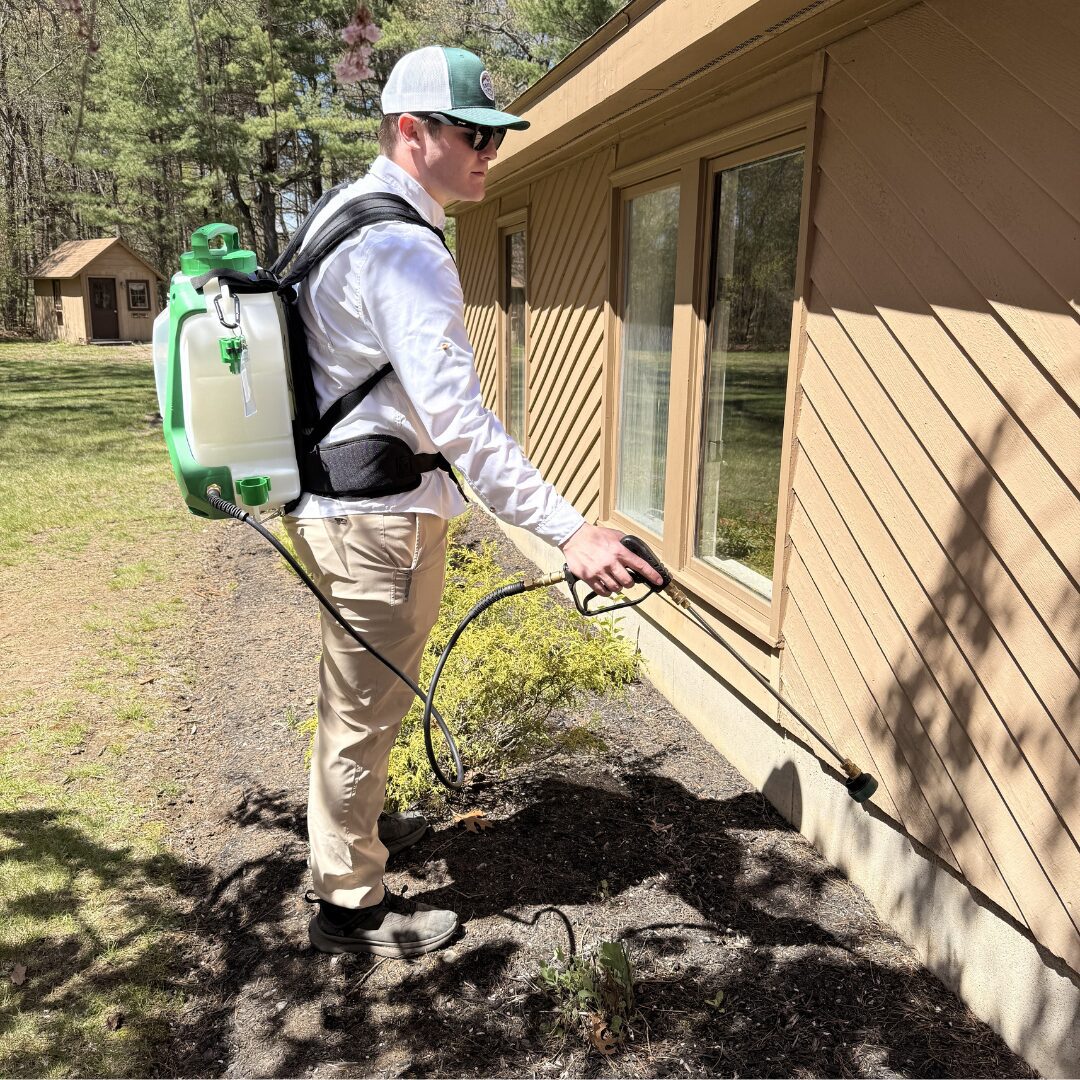
- Non-Repellent Liquid Barriers: We apply specialized, undetectable materials around the exterior foundation. Because the ants cannot detect this barrier, they walk through it freely, transferring the active ingredient back to the nestmates and the queen through grooming.
- Targeted Gel and Granular Baits: We use highly palatable baits formulated specifically for the nutritional preferences of carpenter ants, which change from proteins in the spring to sugars in the summer.
- Direct Void Injection: When a nest is located inside a wall, we drill tiny, inconspicuous 1/8-inch holes to inject dry insecticidal dusts or expanding foams directly into the active galleries, neutralizing the colony instantly.
To learn more about how we apply these advanced IPM strategies in local communities, check out our guide on Mastering Ant Control: Effective Strategies for Middleton Massachusetts.
Preventative Measures for Long-Term Protection
Once your active infestation has been resolved, taking proactive steps to keep them from returning is essential. Because carpenter ants are a natural part of our New England ecosystem, prevention is an ongoing process.
For a comprehensive look at common preventative questions, read our Frequently Asked Questions About Ant Control in Lynnfield Massachusetts.
Moisture Control and Structural Repairs
Because parent colonies require constant moisture to survive, controlling water is your best defense against future invasions.
- Repair All Leaks: Inspect your home regularly for plumbing leaks under sinks, behind tubs, and around dishwashers. Fix roof leaks, damaged flashing, and failing gutters immediately.
- Clean and Maintain Gutters: Clogged gutters cause water to back up under roof shingles, rotting the wooden fascia boards and soffits. This soft, water-damaged wood is highly attractive to searching queens.
- Ensure Proper Ventilation: Use dehumidifiers in damp basements and crawl spaces to keep wood moisture levels low. Ensure attic vents are clear and functioning.
- Eliminate Wood-to-Soil Contact: Ensure that no structural wood of your home — such as siding, deck posts, or door frames — comes into direct contact with the soil. Maintain a gap of at least 6 inches of concrete or gravel.
Landscaping and Exclusion Tactics
You can significantly reduce the pest pressure on your home by making simple adjustments to your yard:
- Trim Tree Branches: Keep all tree limbs and decorative shrubs trimmed back at least 2 to 3 feet from your siding and roofline. Ants frequently use branches as bridges to bypass ground-level treatments.
- Store Firewood Properly: Keep firewood piles elevated off the ground and stored at least 20 feet away from your home. Never bring firewood indoors until you are ready to burn it immediately.
- Remove Dead Wood: Remove old tree stumps, rotting logs, and dead trees from your yard, as these are prime nesting sites for parent colonies.
- Seal Entry Points: Use high-quality silicone caulk to seal cracks in your foundation, gaps around utility penetrations, and spaces around outdoor faucets.
Frequently Asked Questions About Massachusetts Ant Control
Does seeing a single winged ant mean my house has an infestation?
Not necessarily. During the warm summer months (July and August), a single winged queen found near an open door or window is likely a “summer stray” that flew in from outdoors while searching for a nesting site. However, if you find multiple winged ants inside during the late winter or early spring, or if you find shed wings gathered on your window sills, it is a strong indicator of an active indoor nest.
Does homeowners insurance cover carpenter ant damage?
Unfortunately, no. Standard homeowners insurance policies almost never cover damage caused by wood-destroying insects like carpenter ants or termites. Insurance companies classify insect infestations as preventable maintenance issues rather than sudden, accidental losses. This makes early detection and professional prevention incredibly important.
When should I call a professional exterminator for winged ants?
You should contact a professional if you experience any of the following:
- You see multiple winged ants inside your home during late winter or early spring.
- You find piles of sawdust-like frass near walls, baseboards, or joists.
- You hear rustling sounds inside your walls when tapping on the drywall.
- You notice localized wood damage or sagging structural members.
- DIY baiting attempts have failed to resolve the issue after 2 to 3 weeks.
Protect Your North Shore Home with Eastern Pine
Spotting carpenter winged ants inside your home can be stressful, but you don’t have to deal with it alone.
At Eastern Pine Pest Control, we are proud to be the trusted, locally owned pest control authority serving the North Shore of Massachusetts, northern Middlesex County, and Essex County. Our team of experienced technicians understands the unique structural challenges of New England homes, from historic properties in Salem and Ipswich to modern residences in Reading and South Hamilton.
We don’t believe in temporary fixes or generic, repetitive chemical sprays. Instead, we use family-safe Integrated Pest Management (IPM) practices to locate the source of your pest problem, eliminate the nests, and implement long-term exclusion and prevention strategies to protect your home for the future.
If you suspect you have a carpenter ant infestation, or if you want to set up a preventative barrier to keep them out, we are here to help.
Schedule professional ant control with Eastern Pine Pest Control today to request a comprehensive inspection and take the first step toward a pest-free home.