
Carpenter ants don’t eat wood, they excavate it, hollowing out smooth galleries to build a nest. Left alone, that excavation can spread from a single damp entry point into a much larger network, indoors and out. Here’s what carpenter ant control actually involves, and why Eastern Pine Pest Control treats it as a full-colony problem rather than a spray-and-done job.
What Are Carpenter Ants?
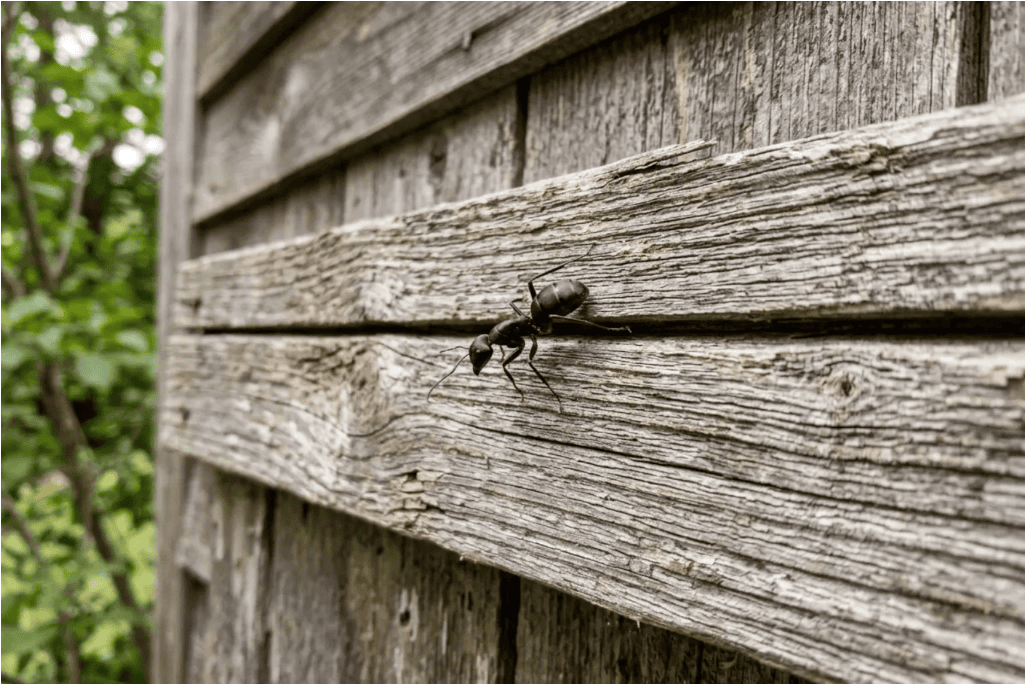
Carpenter ants are large, typically black ants, often a quarter to three-quarters of an inch long, that build their nests inside wood by chewing and removing material to create smooth tunnels and chambers. A colony usually starts with one parent nest, often in a dead tree, stump, or another moist, decaying piece of wood outdoors, and can expand into one or more satellite nests as it grows, sometimes indoors, in wall voids, sills, or other wood that’s stayed damp.
If you want a deeper look at colony structure, caste roles, and seasonal activity patterns, our guide to recognizing carpenter ants covers that in detail. This post focuses on what happens after you’ve found them, how carpenter ant control actually works.
Signs You Might Have Carpenter Ants
A few signs tend to bring homeowners to us specifically:
- Large black ants moving in a steady trail, often most active at night
- Fine, sawdust-like shavings collecting below a wood surface
- Winged ants (swarmers) appearing indoors, especially near windows or doors
- Faint rustling sounds inside a wall or ceiling on a quiet evening
Any of these signs are worth acting on quickly, since carpenter ant control gets simpler and less invasive the earlier a colony is caught.
Swarmers are worth calling out on their own. Seeing winged carpenter ants indoors usually means there’s a mature, established colony nearby, not a brand new one, since a colony needs time to grow before it starts producing reproductives.
From the Field
See Carpenter Ant Control In Action
Left, a swarming event on a client’s porch. Right, a parent nest we documented at the base of a tree.
Where Carpenter Ants Nest
Outdoors, carpenter ants favor wood that’s already soft or decaying, dead trees, old stumps, fence posts, and firewood piles are all common parent nest sites, like the one shown above, with a pile of coarse, sawdust-like frass pushed out of the excavated galleries.
From an outdoor parent nest like that, workers can travel surprisingly far to forage, and a colony under enough pressure will often push a satellite nest into a home nearby, especially wherever wood stays consistently damp:
- Window sills and door frames with water damage
- Deck supports, porch posts, and railings exposed to the weather
- Roof eaves and fascia boards near leaks
- Basement sill plates in contact with foundation moisture
- Bathrooms and kitchens near plumbing fixtures
That’s exactly why real carpenter ant control has to account for satellite nests, not just the trail of workers you can see from a kitchen window.
Why Carpenter Ant Control Isn’t a DIY Job
Spraying the ants you can see rarely solves a carpenter ant problem, because the workers on your counter or windowsill are just a fraction of the colony. The parent nest, and any satellite nests, can be well hidden inside a wall, under a deck, or in a tree well away from the house.
- Killing visible workers doesn’t reach the queen or the nest itself
- A colony often has a parent nest and one or more satellite nests, missing any of them means the problem returns
- Locating an indoor nest usually requires experience reading trail patterns, sounds, and moisture conditions
- Structural wood damage can continue quietly even when ant activity looks minor
How Eastern Pine Approaches Carpenter Ant Control
Eastern Pine’s approach to carpenter ant control is built on Integrated Pest Management, meaning the right treatment, in the right location, in the smallest effective amount, not a blanket application across the whole property. In practice, that looks like:
- A full inspection to trace foraging trails back toward the nest or nests
- Baiting programs that let workers carry treatment back to the colony, including nests we can’t access directly
- Targeted residual treatment at confirmed entry points and trails
- Exclusion recommendations to seal gaps that give ants access to the structure
- Moisture guidance, since damp or decaying wood is what draws carpenter ants in the first place
People and pets should stay clear of any treated area until it’s fully dry.
When to Call a Professional
A few situations are worth scheduling an inspection for rather than waiting:
- You’re seeing large black ants indoors regularly, especially at night
- You’ve found sawdust-like shavings near a wood surface
- Winged ants have appeared inside the house
- You hear faint rustling inside a wall or ceiling
- You can see damaged, excavated wood with smooth, sandpaper-like tunnels
Reaching out at the first sign makes carpenter ant control faster, less invasive, and less likely to involve repair work down the line.
Frequently Asked Questions
Do carpenter ants eat wood?
No. They excavate it to build galleries and chambers for the nest, but they don’t consume it as food. Their diet is mostly other insects, honeydew, and sugary or protein-based scraps around a home.
How much does carpenter ant control cost?
Cost depends on the extent of the activity, how many nests are involved, and how accessible they are. Contact Eastern Pine for an inspection and a specific quote for your property.
Can I get rid of carpenter ants with store-bought spray?
Spray can kill the workers you see, but it doesn’t reach the nest itself, and a colony with a hidden parent or satellite nest will keep producing new workers. Baiting and a proper inspection are usually needed to address the source.
What does it mean if I see winged carpenter ants inside my house?
It usually means there’s a mature colony established somewhere nearby, since young colonies don’t produce swarmers. It’s a strong signal to schedule an inspection.
Will carpenter ants come back after treatment?
They can, if the conditions that attracted them in the first place, usually moisture or an unsealed entry point, aren’t addressed. That’s why exclusion and moisture recommendations are part of a full treatment plan.
Schedule Carpenter Ant
Control Today
Seeing large black ants, sawdust-like shavings, or swarmers indoors? Our team will inspect, locate every nest, and deliver the carpenter ant control your property needs.
Submit a Request