
Wasp nests turn up in places you’d never think to check, tucked into a mailbox, a porch light, or even the hinge of a car’s rear hatch. They’re often smaller and easier to miss than a hornet’s nest, but the sting risk is just as real. Here’s how to identify a wasp nest, where they tend to build, and why Eastern Pine Pest Control handles wasp nest removal as a job for trained technicians rather than a can of spray from the hardware store.
What Is a Wasp Nest?
Several types of wasps commonly build nests around Massachusetts homes, but three of the most common our technicians encounter are paper wasps, yellowjackets, and bald-faced hornets. Each builds a very different type of nest, and knowing what you’re dealing with can help determine the safest approach to treatment.
Paper wasps build small, open, umbrella-shaped nests with exposed hexagonal cells. These nests commonly appear under eaves, shutters, railings, porch lights, grills, and other sheltered areas around a home. They can also turn up in unexpected places, including mailboxes and vehicle hinges.
Yellowjackets build enclosed paper nests, but the nest itself is often hidden. Colonies commonly establish underground or inside wall voids and other protected cavities, so homeowners may only notice a steady stream of yellowjackets entering and exiting a small opening.
Bald-faced hornets build the large, enclosed gray paper nests many homeowners picture when they hear the word “hornet.” These nests are generally above ground and may be attached to trees, shrubs, rooflines, or structures.
While all three are social wasps capable of defending their nests, their nesting habits, colony sizes, and treatment methods can differ significantly.
Wasp Nests Aren’t Always Where You’d Expect
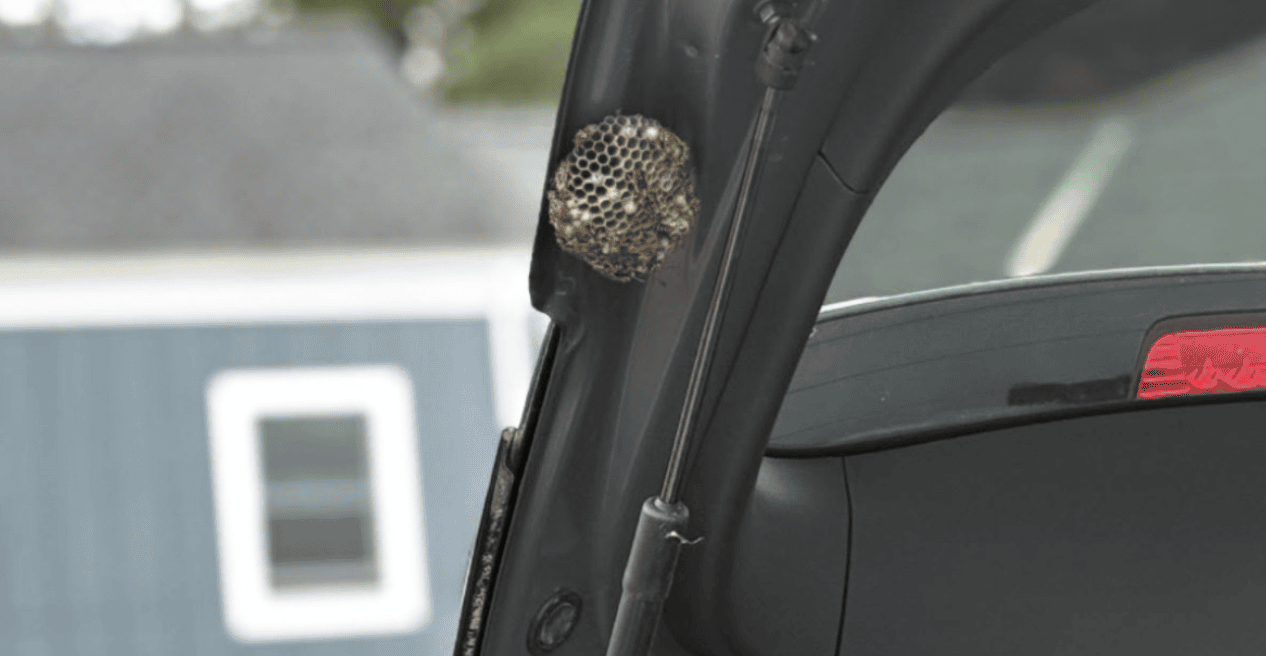
This cluster of paper wasp nests was found built directly into the hinge of a car’s rear hatch, a reminder that wasp nest removal sometimes means checking spots you’d never think to look.
Why Wasp Nest Removal Isn’t a DIY Job
A small paper wasp nest can look harmless, especially early in the season, but wasps defend their nest as a group and will sting repeatedly if disturbed. Reaching into a tight space like a car hinge, mailbox, or shutter to knock down a nest is one of the more common ways people get stung, since there’s often no room to back away quickly.
- Nests in tight mechanical spaces are hard to treat without the right tools
- A partially removed nest can leave survivors that rebuild or relocate close by
- Multiple nests are common on one property once conditions are right, missing one means the problem isn’t solved
- Store-bought sprays often can’t reach wasps tucked deep into a hinge or gap
A trained technician can identify every active nest on a property, not just the one you happened to spot, and remove them without the trial and error of a DIY attempt.
Where Wasp Nests Are Commonly Found
Paper wasps favor small, sheltered gaps that protect the nest from weather while staying close to food sources. Around Massachusetts homes and vehicles, that includes:
- Door, shutter, and gate hinges, including car hatches and trunk lids
- Mailboxes and lamp posts
- Eaves, soffits, and porch ceilings
- Grill covers, patio furniture, and stored outdoor equipment
- Bushes, shrubs, and hedges close to the house
Bushes and hedges deserve a regular check too, a nest tucked into dense foliage can go unnoticed for weeks until someone brushes past it while doing yard work. If you’re trying to tell a wasp nest apart from a hornet’s, our guide to hornet nest removal breaks down the difference, and our guide to hidden yellow jacket nests covers another close relative that hides in many of these same spots.
How Eastern Pine Removes Wasp Nests Safely
Eastern Pine practices Integrated Pest Management, which means using the right treatment, in the right location, in the smallest effective amount, not blanket spraying every gap on a property. For wasp nests, our process includes:
- A full property inspection to find every active nest, not just the visible one
- Treating during low-activity hours, typically early morning or evening
- Applying treatment directly to the nest rather than the surrounding area
- Removing the nest once activity has stopped, so the space isn’t reoccupied
- Flagging conditions, like gaps or clutter, that make a spot attractive to wasps again next season
People and pets should stay clear of the treated area until it’s fully dry and the nest has been confirmed inactive.
See Wasp Nest Removal in Action
Watch how Eastern Pine safely handles an active wasp nest, start to finish.
Follow @easternpinepest on Instagram →When to Call a Professional
A few situations are worth scheduling an inspection for right away rather than waiting:
- The nest is somewhere you can’t safely reach, like inside a hinge, vent, or wall gap
- You’re finding more than one nest on the property
- The nest is near a door, walkway, or another high-traffic area
- Anyone in the household has a known allergy to stings
- The nest has grown noticeably over the past week or two
Frequently Asked Questions
Is it safe to remove a wasp nest myself?
It’s not recommended, especially for nests in tight or hard-to-reach spots. Wasps defend the nest as a group, and a disturbed nest in a confined space like a hinge or vent leaves little room to retreat if they respond defensively.
How much does wasp nest removal cost?
Cost depends on the number of nests, their location, and how accessible they are. Contact Eastern Pine for an inspection and a specific quote for your property.
Why did wasps build a nest in my car?
Paper wasps look for small, sheltered gaps protected from weather. A parked car’s hinges, mirrors, and trim gaps can offer exactly that, especially on vehicles that sit unused for a few days at a time.
How is a wasp nest different from a hornet nest?
Paper wasp nests are open, with the hexagonal cells exposed. Hornet nests are fully enclosed in a papery outer shell. Our hornet nest removal guide has more detail on telling the two apart.
Will wasps come back to the same spot?
Wasps don’t reuse an old nest, but a spot that offered good shelter once can attract a new colony the following season. Sealing gaps and checking known nesting spots each spring helps prevent repeat activity.
Schedule Wasp Nest
Removal Today
Found a wasp nest around your home, in a hinge, mailbox, or somewhere less obvious? Our team will inspect, identify every nest, and remove them safely.
Submit a Request